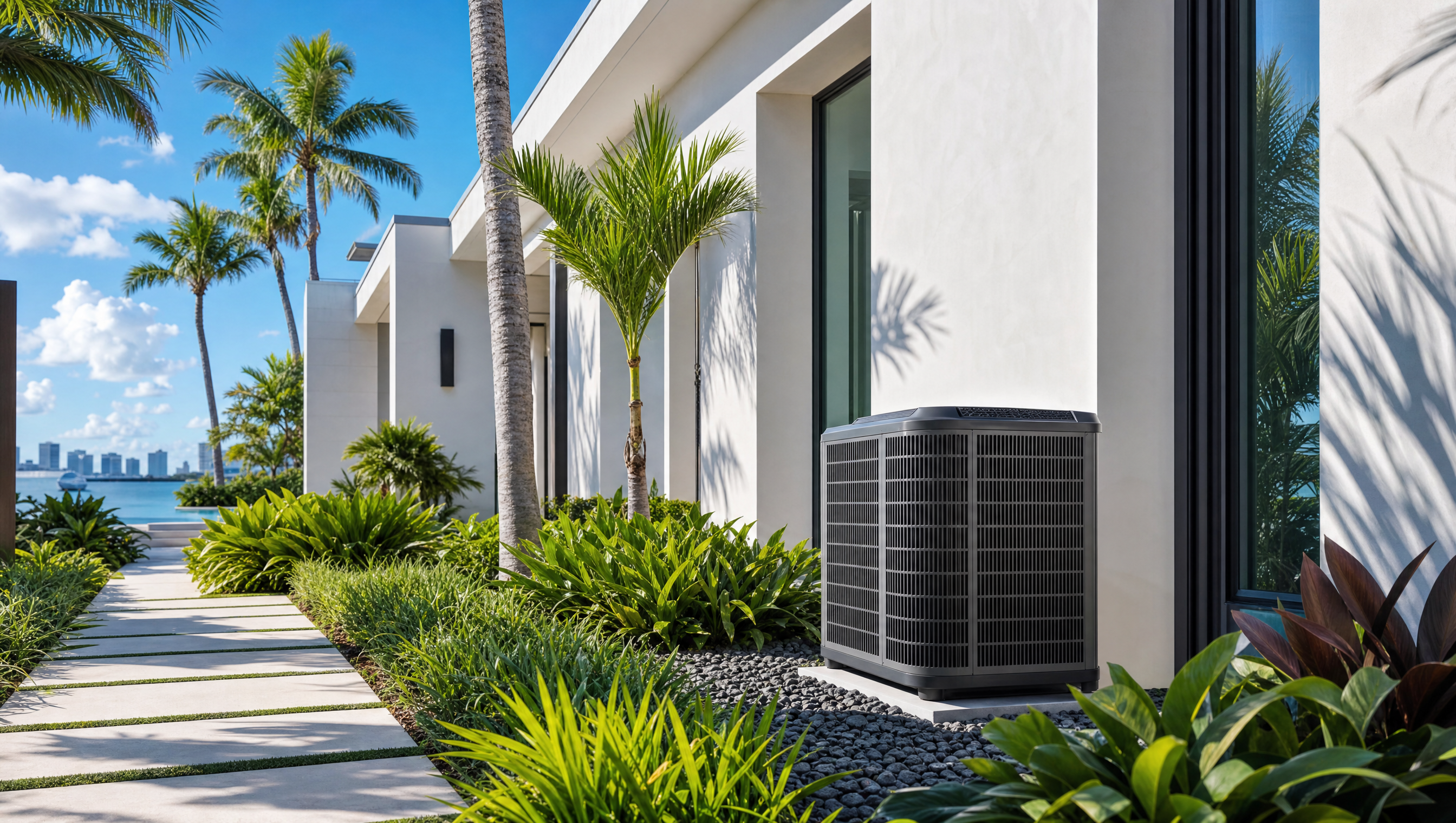
Straight Answer
A cheap oversized unit will cool your house and never dry it out.
Down here humidity is the real problem. A system that is too big short-cycles, leaves the air damp, and dies early. We do the load calculation for your house instead of matching whatever tonnage was there before.
If the ductwork is leaking into your attic, we will tell you that too. A new unit on bad ducts is money you will not get back.
What We Handle
How It Goes
Four steps, no surprises.
Free assessment
We measure the house, look at the ducts, and check what the current system is really doing.
Written scope and price
Equipment, tonnage, SEER, and warranty in plain language.
Permit and schedule
Permitted work, scheduled so you are not without cooling overnight.
Install and commissioning
Charged, balanced, tested, and inspected before we call it done.
Common Questions
Mechanical & HVAC questions, answered.
What size A/C do I actually need in Miami?+
The right way is a Manual J load calculation for your specific house, not just matching whatever tonnage was there before. An oversized unit short-cycles, never pulls the humidity out, and dies early, which is the most common mistake we get called to fix down here.
Why is my house still humid with the A/C running?+
Usually an oversized or short-cycling system, or ductwork leaking into the attic. In South Florida, controlling humidity matters as much as temperature, so we size and seal for both, not just for cold air.
How long does an A/C system last in Florida?+
About 10 to 15 years. Our systems run nearly year-round and coastal salt air is hard on the coils, so Florida units wear faster than the national average. Regular maintenance stretches that out.
Do I need a permit to replace my A/C?+
Yes. A/C changeouts are permitted and inspected in Miami-Dade, and larger mechanical jobs also require a recorded Notice of Commencement. We handle the paperwork and schedule so you are not without cooling overnight.
Is a new A/C worth it if my ducts are bad?+
Not on its own. A new, efficient unit on leaky ducts is money you will not get back. We check the ducts as part of the assessment and tell you if sealing or replacing them is the better spend.
What size A/C do I actually need for my house?+
The right size comes from a Manual J load calculation, not a guess off square footage. In Florida we generally figure roughly 400 to 500 square feet per ton, but insulation, windows, ceiling height, and sun exposure all move it. If a contractor quotes tonnage without measuring, they are guessing.
Should my thermostat fan be set to ON or AUTO?+
AUTO, almost always. On ON, the fan runs constantly and re-evaporates moisture back into the house, which is why it feels humid. On AUTO the fan only runs while cooling, so the system actually pulls humidity out — a big deal in South Florida.
How do I protect my A/C from salt air near the coast?+
Rinse the outdoor coil with fresh water regularly (roughly every couple of weeks within a few miles of the water), consider coated coils on a new unit, and place the condenser out of direct salt spray where possible. Salt corrosion is the main reason coastal units die early, so we plan for it.